Written by Ben Adams (ben@wpgusa.org)
A leaking commercial roof puts a property manager in a tough spot, and the commercial roof restoration versus replacement question usually lands at the worst time: tenants are calling about water stains, the roof is clearly past its best years, and the capital budget process for a full replacement can take months to work through. In the meantime, water keeps finding its way in.
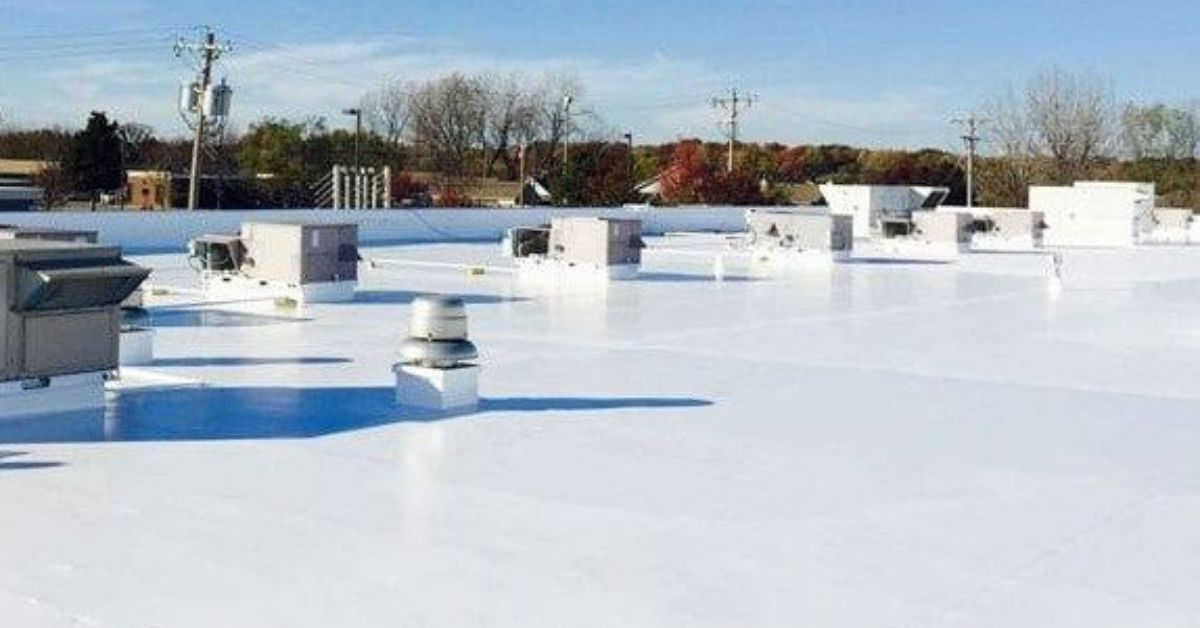
Full tear-off and replacement isn’t the only option. On many low-slope commercial roofs — retail centers, warehouses, office buildings, parking structure canopies — a fluid-applied roof coating — commercial roof restoration with a fluid-applied system — can restore and re-seal an aging membrane at a fraction of replacement cost, without taking the building out of service during construction. The right call depends on the actual condition of the roof, not just its age.
This article covers what typically causes commercial roof leaks, the warning signs worth inspecting for, how to think through commercial roof restoration versus full replacement, a few mistakes to avoid while a leak is being managed, and what to do before committing budget either way.
Why Commercial Roofs Start Leaking
Most low-slope and flat commercial roofs fail gradually rather than all at once. Common contributors include:
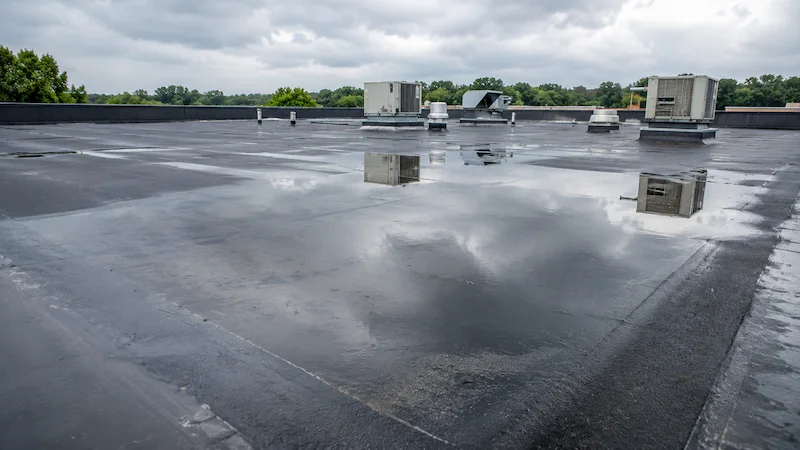
- Ponding water that sits on flat sections after rain instead of draining, which accelerates membrane breakdown over time
- UV exposure and weathering that dries out and cracks the membrane, especially on roofs well past their original service life
- Failed seams and flashing around HVAC curbs, vent penetrations, and roof edges — often the first place a roof actually leaks, even when the field membrane looks fine
- Deteriorated expansion joints where the roof meets a parapet wall or an adjoining structure, which move independently from the rest of the roof and fail on their own schedule
- Foot traffic and equipment servicing that punctures or wears through the membrane around rooftop units
- Deferred maintenance — small issues that go unaddressed until they become active leaks
Warning Signs Worth Inspecting For
Some of these are visible from inside the building; others require getting up on the roof:
- Water stains or discoloration on ceiling tiles, especially on the top floor
- Ponding water still visible more than 48 hours after a rain event
- Cracked, blistered, or alligatored membrane surface
- Rusted, lifted, or separated flashing at edges, curbs, and penetrations
- Visibly deteriorated or missing expansion joint material
- Soft or spongy spots underfoot on the roof, which can indicate saturated insulation below the membrane
- A noticeable jump in heating or cooling costs, which can point to insulation that’s already holding water
Commercial Roof Restoration vs. Full Replacement
Both are legitimate paths — the deciding factor is the condition of what’s underneath the membrane, not just the roof’s calendar age.
When a Fluid-Applied Coating Makes Sense
If the insulation and roof deck are still sound and the membrane’s main problems are surface weathering, minor cracking, and failed seams or flashing, a fluid-applied coating can seal those points and add years of service life. Because it’s applied over the existing roof rather than tearing it off, the building typically stays in use throughout the work, and the cost per square foot is meaningfully lower than a full tear-off and replacement.
Commercial roof restoration restores the surface — it can’t fix saturated insulation or a damaged deck underneath. That’s why the repair decision starts with what’s below the membrane, not the roof’s age.
When Full Replacement Is the Right Call
A coating can’t fix what’s happening below the membrane. If an inspection finds saturated insulation, a damaged roof deck, or membrane failure that is too widespread or structural for a coating to bridge, restoring the surface only delays a larger problem—and a coating applied over a compromised roof won’t hold up. A long history of recurring leaks despite repeated patching may also indicate that broader commercial roofing services, including full roof replacement, offer a more reliable path than another temporary repair.
What Not to Do With a Leaking Commercial Roof
- Don’t keep patching the same recurring leak location without figuring out why it keeps failing — a leak at the same spot repeatedly is usually a flashing or expansion joint problem, not bad luck.
- Don’t let ponding water sit indefinitely while a capital budget decision works through approval — standing water actively shortens whatever service life the roof has left.
- Don’t assume every aging roof is automatically a coating candidate — that call depends on an actual on-roof evaluation of the substrate and insulation, not the roof’s age alone.
- Don’t treat expansion joints as part of the field membrane — they’re a separate material that fails on its own timeline and needs its own inspection.
Get the Roof Evaluated Before Budgeting
Whether restoration or replacement is the right move for a specific roof comes down to what an inspection finds under the membrane — not the roof’s age or how long it’s been leaking. Getting that evaluation done before locking in a capital budget number means the number reflects the roof’s actual condition rather than a worst-case assumption.
The Waterproof Group evaluates commercial roofs by getting on the roof and checking the substrate directly, not estimating condition from photos or the building’s age. That’s the same approach we bring to expansion joints, traffic coatings, and the rest of the building envelope — self-performed, not subcontracted out.