
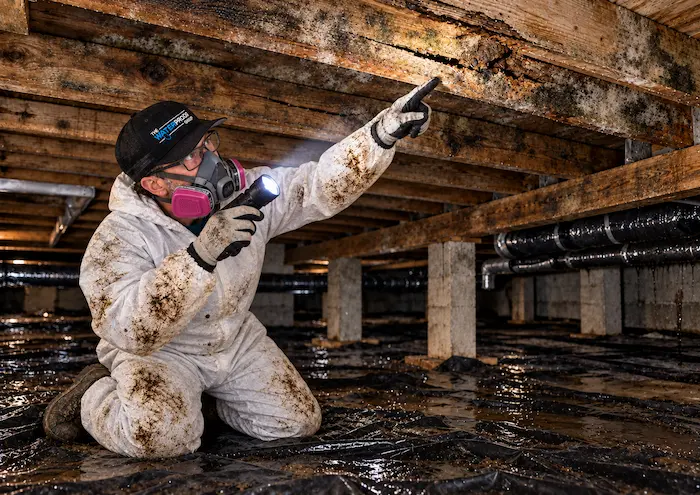
Crawl space moisture damage can be easy to ignore because the problem is hidden beneath the house. Unfortunately, the damage does not remain hidden forever. Persistent humidity, standing water, plumbing leaks and exposed soil can eventually affect the wooden structure supporting the floors above.
For homeowners in Metro Atlanta, crawl space moisture damage is especially common because of our humid climate, periods of heavy rainfall and the amount of moisture held within Georgia’s clay soil. Even when there is no obvious flooding, elevated humidity beneath the house may gradually damage floor joists, beams, sill plates and subflooring.
Yes, crawl space moisture can cause wood rot and structural damage. When framing remains damp for extended periods, conditions become favorable for fungal growth and decay. Over time, affected joists, beams and subflooring can weaken, contributing to soft, sagging or uneven floors inside the home.
Where Does Crawl Space Moisture Come From?
A crawl space does not need to flood for moisture problems to develop. Water vapor continuously rises from uncovered soil, increasing the humidity beneath the house. Open crawl space vents can also allow warm, humid outdoor air to enter and condense against cooler framing, ductwork and other surfaces.
Other common moisture sources include:
- Poor exterior grading or downspouts discharging near the foundation
- Groundwater entering around the crawl space footing
- Plumbing or HVAC condensation-line leaks
- Missing, damaged or poorly installed vapor barriers
- Open foundation vents and unsealed penetrations
- Improper drainage around the home
- Water collecting after periods of heavy rain
The source must be identified before repairs are recommended. Covering damaged wood or installing new supports without correcting the moisture problem can allow the deterioration to continue.
How Moisture Damages Wood Framing
Wood framing can safely absorb and release a certain amount of moisture as conditions change. Crawl space moisture damage develops when the framing stays excessively damp and cannot dry properly.
Prolonged moisture creates conditions that allow wood-decay fungi to grow. As decay progresses, the wood can lose density, stiffness and its ability to carry the loads placed upon it. A floor joist may still appear intact from a distance while its surface has become soft, flaky or easily penetrated.
Moisture can also cause framing to swell, shrink, twist or warp. Repeated changes in moisture content may contribute to movement within the floor system, resulting in squeaking, popping, uneven flooring or gaps along walls and baseboards.
Not every dark stain indicates active wood rot, and surface mold does not automatically mean that a floor system has failed. However, staining, fungal growth or damp framing should be evaluated to determine whether the wood remains structurally sound.
Which Parts of the House Can Be Affected?
The floor system above a crawl space consists of several interconnected components. Moisture damage to one part can place additional stress on the surrounding structure.
Floor joists may crack, deflect or deteriorate, especially near their bearing points. Main beams and drop girders may begin to sag if they have been weakened or improperly supported. Sill plates and rim joists located around the perimeter of the house may rot when water enters near the foundation wall.
The underside of the subfloor can also absorb moisture. This may cause hardwood flooring to cup, finished floors to feel soft or sections of the floor to become uneven.
Engineered floor systems require particular attention. Engineered I-joists and floor trusses use thinner components and connection points that may react differently to moisture than traditional dimensional lumber. Damaged engineered framing should be evaluated carefully rather than repaired using a one-size-fits-all approach.
Warning Signs of Crawl Space Moisture Damage
Homeowners often notice changes inside the house before they realize there is a problem underneath it. Common signs of crawl space moisture damage may appear inside the home or beneath the floor system. Warning signs can include:
- Floors that sag, slope or contain a noticeable low area
- Soft, bouncy or unstable flooring
- Squeaking, cracking or popping sounds while walking
- Cupped or warped hardwood flooring
- Doors that rub, stick or no longer close properly
- Gaps appearing between flooring, walls or baseboards
- Musty odors inside the home
- Visible mold, fungal growth or staining on crawl space framing
- Cracked, split or deteriorated floor joists
- Wet insulation hanging beneath the floor
- Standing water, muddy soil or condensation in the crawl space
These symptoms do not all have the same cause. Sagging floors may also result from undersized framing, excessive joist spans, improper notching, damaged engineered trusses or previous plumbing and electrical alterations. A proper inspection should evaluate both moisture conditions and the design and condition of the floor system.
Can the Wood Be Saved, or Does It Need to Be Replaced?
The answer depends on the amount of damage and whether the affected member can still perform its structural function. Wood that is stained but remains solid may not require replacement once the source of moisture has been corrected. Severely decayed, split or structurally weakened framing may need reinforcement or replacement.
Possible structural repairs include sistering damaged joists, replacing failed sections of framing, installing additional beams or drop girders, and adding properly designed support posts. In some situations, steel beams and adjustable support columns may be used to stabilize the floor system and correct sagging.
Any lifting must be performed carefully. A floor that has settled gradually over several years may not respond well to being forced back into position all at once. Attempting to lift it too quickly can damage flooring, drywall, doors, cabinetry and other finishes.
Structural Repair Alone Will Not Solve a Moisture Problem
Replacing a damaged floor joist without controlling the water or humidity is like repairing a roof without stopping the leak. The new material remains exposed to the same conditions that damaged the original framing.
Depending on the property, correcting crawl space moisture damage may require a combination of:
- Exterior grading and drainage improvements
- Crawl space perimeter drainage
- A sump pump or gravity-discharge system
- A properly installed vapor barrier
- Full crawl space encapsulation
- Sealing foundation vents and outside-air openings
- A properly sized crawl space dehumidifier
- Plumbing or HVAC repairs
Standing water should generally be addressed before encapsulation. A liner can control ground vapor, but it should not be expected to replace a drainage system when groundwater is actively entering the crawl space.
Full encapsulation uses a reinforced liner sealed across the ground, foundation walls and piers to help isolate the crawl space from soil moisture and humid exterior air. When necessary, a dehumidifier is added to maintain controlled humidity after the space has been sealed.
Why Crawl Space Moisture Is Common Around Atlanta
Metro Atlanta homes experience a combination of high outdoor humidity, heavy rain and moisture-retentive soil. Water can collect near a foundation when gutters overflow, downspouts terminate too close to the house or the surrounding grade directs runoff toward the crawl space.
Older homes may have open foundation vents and minimal ground coverings that were considered acceptable when the house was built. In our humid climate, however, outside air does not necessarily dry a crawl space. During warmer months, introducing humid air can increase condensation and moisture on cooler building materials.
That is why the correct solution must be based on the conditions at the individual house. Some homes primarily need exterior drainage improvements, while others require waterproofing, encapsulation, dehumidification or structural repairs. Regular inspections can help Atlanta homeowners identify crawl space moisture damage before extensive structural repairs are needed.
Inspect the Moisture Problem and the Structure Together
Crawl space moisture and structural damage are closely connected, but they are sometimes treated as separate problems. One contractor may focus only on controlling humidity, while another looks only at the sagging floor.
A complete evaluation should determine:
- Where the moisture is coming from
- Whether the crawl space has active water intrusion or elevated humidity
- Which structural components have been affected
- Whether damaged framing needs repair, reinforcement or replacement
- What moisture-control system will protect the repairs moving forward
Preventing future crawl space moisture damage requires correcting the water or humidity source in addition to repairing weakened framing. The Waterproof Group provides crawl space and structural evaluations throughout Marietta and Metro Atlanta. Our team can inspect the framing, determine why the floor system is moving and recommend the appropriate combination of waterproofing, encapsulation, dehumidification and structural repair.
Learn more about our crawl space solutions and sagging-floor structural repairs.
Frequently Asked Questions
Does surface mold mean my floor joists are structurally damaged?
Not necessarily. Surface mold indicates that moisture conditions are supporting fungal growth, but it does not automatically mean the wood has lost its structural strength. The framing should be inspected for softness, decay, cracking, deflection and damage around its bearing points.
Can a dehumidifier stop wood rot?
A dehumidifier can help control humidity, but it may not solve standing water, groundwater intrusion or drainage problems. The water source should be corrected, the crawl space properly sealed when appropriate, and damaged wood evaluated before relying on dehumidification.
Will encapsulation repair damaged floor joists?
No. Encapsulation helps control future moisture exposure, but it does not restore strength to wood that has already decayed or failed. Structural repairs and moisture control may need to be performed as parts of the same project.
Why are my floors sagging if the crawl space wood is not rotten?
Sagging may also be caused by joists that are undersized, spans that are too long, insufficient beam support, cracked framing, improper notching or holes cut for plumbing and electrical work. Moisture is an important possibility, but it is not the only cause.
Should wet crawl space insulation be replaced?
Insulation that is saturated, contaminated or falling away from the floor system may need to be removed. The moisture source should be corrected and the framing allowed to dry before replacement materials are installed.
How quickly should crawl space moisture damage be addressed?
Active water intrusion and visibly deteriorating framing should be addressed promptly. Waiting can allow decay to spread, increase structural repair costs and make floor movement more difficult to correct.
Schedule a Crawl Space Evaluation
If your floors are sagging, your house smells musty or you have noticed moisture beneath your home, the problem is unlikely to correct itself. An inspection can determine whether you are dealing with humidity, active water intrusion, damaged framing, inadequate structural support or a combination of conditions.
The Waterproof Group provides crawl space waterproofing, encapsulation and structural repairs throughout Marietta and Metro Atlanta.