Water leaking through an underground concrete wall can become a serious problem for commercial property owners. Whether the intrusion occurs in an elevator pit, utility vault, underground parking structure, or below-grade foundation, groundwater can create persistent moisture problems and damage building materials.
Traditionally, exterior waterproofing repairs often involve excavating around the structure to expose the foundation wall. But what happens when that wall is beneath a parking lot, sidewalk, building addition, or other area where excavation would be expensive or impractical?
In certain situations, curtain wall grouting offers an alternative method of below-grade waterproofing without exterior excavation. Using specialized polyurethane injection materials, waterproofing contractors can create a barrier behind an existing wall to help stop groundwater before it enters the structure.
What Is Curtain Wall Grouting?
Curtain wall grouting, sometimes called polyurethane curtain grouting, is a waterproofing repair technique that involves injecting chemical grout through an existing wall and into the soil or voids immediately behind it.
The injected material reacts with moisture and forms a water-resistant barrier along the exterior side of the structure. Rather than simply coating the inside surface of a leaking wall, the objective is to interrupt groundwater intrusion on the side where the water originates.
This method can be particularly useful when water is entering through multiple cracks, construction joints, porous concrete, or other areas where the exact leakage path is difficult to identify.
Curtain grouting is not the same as injecting a single visible foundation crack. Crack injection targets a specific opening, while curtain grouting treats a broader area behind the structure.
Why Below-Grade Structures Develop Groundwater Leaks
Underground structures are constantly exposed to changing soil moisture and groundwater conditions. During periods of heavy rainfall, water can accumulate around foundation walls and create hydrostatic pressure.
Hydrostatic pressure is the force exerted by standing or accumulated water against a structure. As that pressure increases, groundwater may find its way through cracks, deteriorated joints, pipe penetrations, and other vulnerable locations.
Common areas where below-grade water intrusion occurs include:
- Commercial foundation walls and retaining walls
- Elevator pits and equipment vaults
- Underground parking garages
- Utility tunnels and below-grade corridors
- Concrete construction joints and wall penetrations
- Underground mechanical and pump rooms
The challenge is that the location where water appears inside a building may not be the exact location where it enters the exterior wall. Groundwater can travel along joints, cracks, and concealed pathways before becoming visible.
That is one reason a proper leak investigation is important before selecting a waterproofing repair method.
How Polyurethane Curtain Wall Grouting Works
The process begins with an evaluation of the structure, groundwater conditions, and areas of active water intrusion.
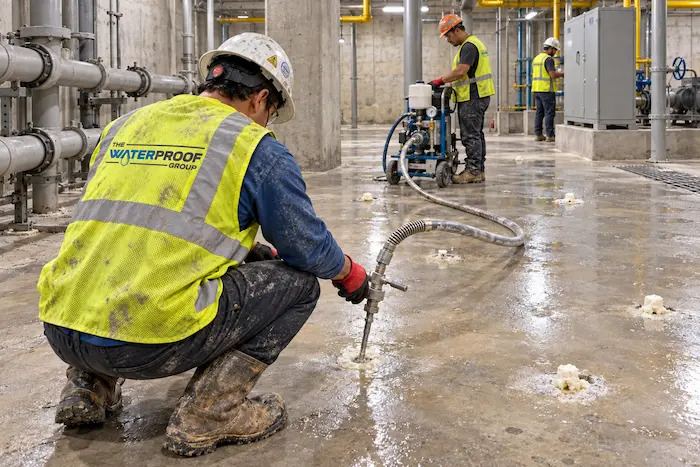
When curtain grouting is appropriate, technicians drill a planned pattern of injection holes through the existing wall. Specialized injection equipment is then used to introduce water-reactive polyurethane grout into the area behind the concrete.
As the grout encounters moisture, it reacts and expands or cures according to the material’s formulation. The objective is to fill connected voids and create an overlapping barrier that limits groundwater movement toward the structure.
Injection typically progresses through a planned sequence to develop coverage across the affected area. After the material has reacted, the injection locations are sealed and the repair is evaluated.
The specific grout formulation, injection pressures, hole spacing, and installation approach depend on the structure and site conditions.
At The Waterproof Group, we use specialized polyurethane injection materials, including products manufactured by Alchatek, to address groundwater intrusion in below-grade structures. Alchatek’s technical resources explain how curtain grouting creates a waterproof barrier behind existing concrete walls without requiring exterior excavation.
The Advantages of Waterproofing Without Excavation
One of the biggest advantages of curtain wall grouting is the potential to perform waterproofing repairs from inside an existing structure.
On many commercial properties, exterior excavation can involve more than simply digging alongside a foundation. It may require removing pavement, relocating utilities, disrupting tenant access, or working around structural elements.
Curtain grouting can offer several advantages when conditions are suitable.
Reduced excavation and surface disruption. Accessing the exterior side of a wall may not be necessary, helping preserve surrounding pavement, landscaping, and other improvements.
Access to difficult underground locations. Elevator pits, utility vaults, tunnels, and similar spaces may be accessible from the interior even when the exterior wall is not.
Treatment of widespread leakage. Where groundwater is entering through numerous small openings, a grout curtain may be more practical than attempting to identify and inject every individual leak.
Potentially reduced repair disruption. Avoiding extensive excavation may reduce the amount of demolition, restoration, and interruption associated with certain repairs.
These advantages do not mean curtain grouting is appropriate for every leaking foundation. The repair must be selected based on the actual source of water intrusion and the condition of the structure.
Curtain Wall Grouting vs. Traditional Exterior Waterproofing
Traditional exterior below-grade waterproofing generally involves exposing the foundation wall and installing a waterproofing membrane, often together with drainage components and foundation drainage improvements.
For accessible structures, this can be an effective approach because the contractor can inspect and prepare the exterior wall directly.
Curtain wall grouting takes a different approach. Instead of exposing the entire exterior surface, technicians inject waterproofing material behind the existing wall through strategically located openings.
Both methods are intended to control groundwater intrusion, but they are not interchangeable in every situation.
For example, a structure with inadequate site drainage or a failed foundation drainage system may require drainage improvements in addition to leak sealing. Likewise, deteriorated or structurally damaged concrete may need separate repairs.
The best solution depends on the construction type, accessibility, water pressure, leak locations, and overall condition of the building.
When Is Curtain Wall Grouting the Right Solution?
Curtain grouting is worth considering when a below-grade structure experiences persistent groundwater intrusion and exterior access is limited.
It may be particularly appropriate when multiple leaks are present, water is moving through difficult-to-trace pathways, or previous localized repairs have not adequately controlled the problem.
However, not every wet foundation wall needs chemical grouting. Some leaks can be addressed through targeted crack injection, drainage improvements, exterior waterproofing membranes, or a combination of methods.
An experienced waterproofing contractor should evaluate the structure before recommending a repair.
Commercial Below-Grade Waterproofing in Atlanta
Metro Atlanta commercial properties include a wide range of below-grade structures, from parking garages and elevator pits to utility vaults, retaining walls, and underground equipment rooms.
When groundwater enters these spaces, choosing the correct waterproofing method is essential to protecting the property and limiting recurring water damage.
The Waterproof Group provides commercial below-grade waterproofing services throughout Metro Atlanta and surrounding Georgia communities. Our approach includes evaluating the source of water intrusion and recommending suitable solutions, which may include waterproofing membranes, drainage improvements, crack injection, or curtain wall grouting.
If your commercial property has an underground water leak or a foundation wall that cannot be accessed from the exterior, contact The Waterproof Group to schedule an inspection. We’ll evaluate the conditions and help determine whether curtain wall grouting or another below-grade waterproofing method is appropriate.