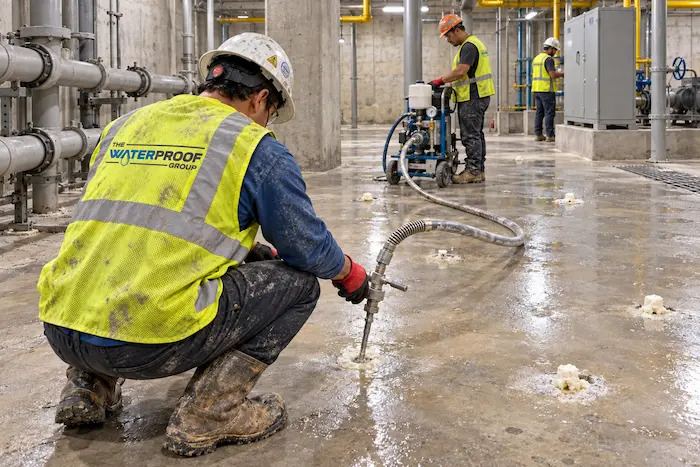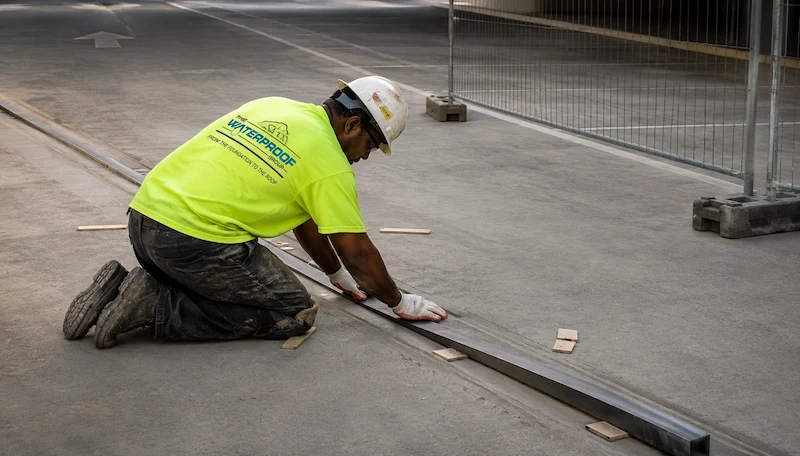
Parking deck expansion joint repair becomes necessary when the joint material separating concrete sections begins to crack, split, or allow water through. If you manage a parking deck, plaza deck, or commercial building in Metro Atlanta, a leaking expansion joint isn’t something to ignore. Expansion joints are one of the most common sources of leaks in parking structures, and a small failure at the deck surface can eventually lead to deterioration below.
Expansion joints are built into the structure on purpose — they let concrete panels move slightly as temperatures rise and fall without cracking the deck itself. But the joint material absorbs the brunt of that movement, along with UV exposure, constant traffic loading, and Metro Atlanta’s mix of heavy summer rain and occasional winter freeze-thaw swings. Over time, the joint material wears out long before the concrete around it does.
This article covers what typically causes expansion joints to fail, the warning signs worth walking the deck to check for, the difference between a localized repair and a full joint replacement, and when a leak has gone far enough that a DIY patch job isn’t the right call anymore.
Why Expansion Joints Fail
Expansion joint systems are manufacturer-specific products designed to flex with the structure while keeping water out. Like any flexible material exposed to the elements, they have a service life — typically 5 to 10 years depending on traffic volume and exposure — and several things push a joint toward failure faster than that:
- Constant traffic loading: every vehicle that crosses a joint compresses and flexes the material, and that repeated stress eventually causes cracking, tearing, or the joint pulling loose from the concrete.
- UV and weather exposure: sun exposure on upper decks and open-air levels breaks down rubber and sealant compounds over time, making them brittle.
- Thermal movement: Metro Atlanta’s hot, humid summers and occasional winter freezes mean the structure is constantly expanding and contracting, which is exactly the movement the joint is supposed to absorb — but that cycling also accelerates wear on aging material.
- Age and past-due replacement: a joint installed a decade or more ago is statistically more likely to be near or past its expected service life, even if it looks intact from a distance.
- Poor original installation or the wrong product for the application: expansion joint material is specified by movement capability and traffic rating, and a joint that was undersized or installed without proper anchoring tends to fail earlier.
Warning Signs Worth a Closer Look
Most expansion joint failures don’t announce themselves with a dramatic leak — they show up gradually, and often on the level below the joint rather than at the joint itself. Walk both the deck surface and the level underneath it and look for:
- Visible cracking, tearing, or hardening of the joint’s rubber, foam, or sealant material
- Separation between the joint system and the surrounding concrete
- Active dripping, damp streaks, or standing water on the level below a joint line
- Rust staining on concrete or exposed structural steel near a joint
- White, chalky mineral deposits (efflorescence) on concrete surfaces below the joint
- Spalled or cracked concrete immediately adjacent to the joint
- Loose, missing, or visibly displaced joint cover plates or nosing
If you’re seeing more than one of these signs, or the same spot has needed attention more than once, it’s worth having someone look at the joint before the next heavy rain rather than after.
Parking Deck Expansion Joint Repair Options
The right parking deck expansion joint repair depends on how much of the joint has actually failed. A joint that’s mostly sound with one damaged section is a different job than a joint that’s hardened or separated along its full run.
Resealing or Patching a Localized Failure
When only a section of the joint has split, separated, or lost its seal while the rest of the system is still in good condition, it’s often possible to remove just the damaged section and reinstall compatible joint material, or reseal it with a product engineered for that specific joint system. This approach can extend the life of the overall system without the cost or downtime of a full replacement, provided it’s caught early.
Full Joint System Replacement
When the material has broadly hardened, cracked, or pulled away in multiple locations — or the joint is past its expected service life — replacing the full run of joint material, along with the flashing and nosing that anchor it into the concrete, is usually the more cost-effective long-term fix. This is a manufacturer-specific product, not something a generic hardware-store caulk or sealant is built to substitute for; the material has to accommodate ongoing structural movement, not just fill a gap.
Mistakes That Make an Expansion Joint Leak Worse
- Caulking over a moving joint with a rigid, non-elastomeric sealant — it will crack again as soon as the deck flexes, often within one heat-cool cycle.
- Waiting until the leak shows up as a stain on the ceiling below before addressing it — by that point, water has typically already reached the reinforcing steel.
- Treating a small surface crack as purely cosmetic — once water reaches steel reinforcement, corrosion and the resulting concrete spalling become a structural issue, not just a leak.
- Re-patching the same spot repeatedly without checking whether the joint system as a whole is near the end of its service life — recurring patch jobs on an aging joint are often more expensive over time than one properly scoped replacement.
If a joint is leaking in multiple locations, you’re seeing rust staining or exposed rebar, or a patch job hasn’t held, it’s time for an evaluation from a waterproofing contractor experienced with parking structures rather than another round of surface patching.
Next Step: Get the Joint Evaluated Before It Becomes a Structural Repair
Parking deck expansion joint repair is far less disruptive when problems are addressed before water intrusion damages the surrounding concrete and reinforcing steel. Left alone, water finds its way to the reinforcing steel, and what started as a joint repair turns into a corrosion and spalling repair — a bigger job, at a higher cost, with more disruption to the property. The Waterproof Group provides parking deck expansion joint repair and leak evaluations throughout Metro Atlanta, diagnosing whether a joint needs a localized repair or full replacement. The Waterproof Group self-performs the work with its own local crew rather than subcontracting the Waterproof Group providing you with a professional experience and a professional installation through our trained staff. If you’re seeing cracking, staining, or active leaks near a joint line, a commercial waterproofing evaluation is the fastest way to find out what’s actually going on before it grows into a bigger repair.