Water appearing inside a commercial property is frequently blamed on the roof. Sometimes that diagnosis is correct—but commercial building water leaks can also originate at exterior wall joints, windows, expansion joints, elevated decks, below-grade foundations and other parts of the building envelope.
The location where water becomes visible is not always where it entered the building. Water can travel behind exterior cladding, above ceilings, along structural components or beneath waterproofing membranes before finally appearing indoors. Repairing the visible stain without finding the true entry point often leads to repeated leaks, frustrated tenants and money spent on repairs that do not solve the problem.
Commercial building water leaks should be investigated as a complete building-envelope problem. The roof, exterior walls, sealants, penetrations, expansion joints, decks, foundations and drainage systems may all need to be considered before the correct waterproofing repair can be selected.
Why Commercial Building Water Leaks Can Be Difficult to Diagnose
Commercial buildings contain numerous transitions between different materials and waterproofing systems. Roof membranes terminate at parapet walls. Windows and doors connect to exterior cladding. Expansion joints separate moving sections of a structure. Elevated decks contain drains, penetrations and transitions into vertical walls.
Each transition represents a potential water-entry point.
Wind-driven rain can make the investigation even more difficult. A wall may remain dry during light vertical rainfall but leak when wind pushes water against a particular side of the building. Water may also enter several floors above the location where the interior damage appears.
Before repairs begin, it is important to determine whether the water is coming from the building envelope or from an interior source such as plumbing, fire-suppression piping, HVAC equipment or condensation. A waterproofing contractor cannot correct a leaking domestic water line, and a plumber cannot repair a failed exterior waterproofing membrane. For suspected building envelope leaks, a professional commercial leak investigation can help identify the source of water intrusion and determine which repairs are appropriate.
1. Commercial Roofs and Roof Transitions
Commercial roofs are a common source of water intrusion, but the problem is not always a large opening in the main roof membrane. Leaks frequently develop around penetrations, flashing, drains, curbs, seams, parapet walls and roof-to-wall transitions.
Flat and low-slope roofs may also develop ponding water when drains become obstructed or the roof does not drain properly. Standing water can increase stress on vulnerable seams, flashing details and deteriorated areas of the roofing system.
Water entering through a roof can travel beneath the membrane or along the roof deck before reaching the interior. That is why the ceiling stain may not be located directly below the failure.
A professional commercial roof leak investigation and repair can determine whether the property needs a localized repair, drainage correction, restoration coating or a more extensive roofing solution.
An aging but structurally sound roof may also be a candidate for a commercial roof coating system. Fluid-applied roof restoration creates a seamless waterproof membrane over a properly prepared existing roof and may extend its service life without a complete tear-off.
2. Failed Sealants Around Windows, Doors and Wall Joints
Commercial buildings contain hundreds or sometimes thousands of linear feet of sealant. It is commonly installed around windows, doors, louvers, penetrations, panel joints, masonry transitions and other exterior openings.
Sealants must remain bonded while accommodating movement between building materials. Over time, exposure to sunlight, temperature changes, moisture and repeated building movement can cause sealants to crack, split, shrink or pull away from adjoining surfaces.
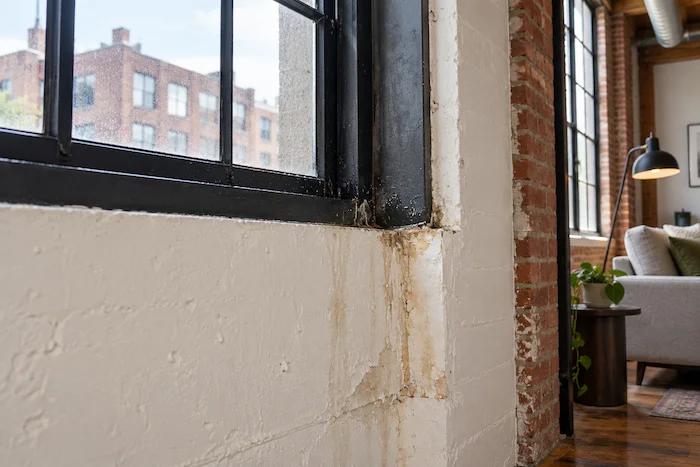
Even a relatively small separation can allow wind-driven rain to enter behind the exterior façade. Once behind the cladding, water may travel within the wall assembly before appearing around windows, interior drywall or flooring.
Applying new caulk over failed material is not necessarily a proper repair. The deteriorated sealant may need to be removed, the joint cleaned and prepared, and a compatible sealant installed with the correct joint dimensions and backing material.
Learn more about professional commercial caulking and sealant replacement.
3. Exterior Walls and Failed Air or Weather Barriers
The exterior cladding is only one part of a commercial wall assembly. Behind brick veneer, EIFS, stucco, metal panels and other façade materials should be a properly integrated air and weather barrier that directs water back toward the exterior.
If the barrier is missing, damaged or poorly connected around openings and transitions, moisture may reach wall sheathing, framing, insulation and interior finishes. These failures can remain concealed until staining, bubbling paint, musty odors or deteriorated materials become visible inside the building.
The exterior crack or opening where water enters may be located well above or to the side of the interior damage. Repairing the inside surface will not stop water that continues to enter behind the cladding.
Fluid-applied air and weather barrier systems create a continuous membrane over properly prepared wall substrates. These systems are used in new construction and restoration projects to help control air leakage and moisture intrusion behind exterior cladding.
4. Expansion Joints and Building-Movement Locations
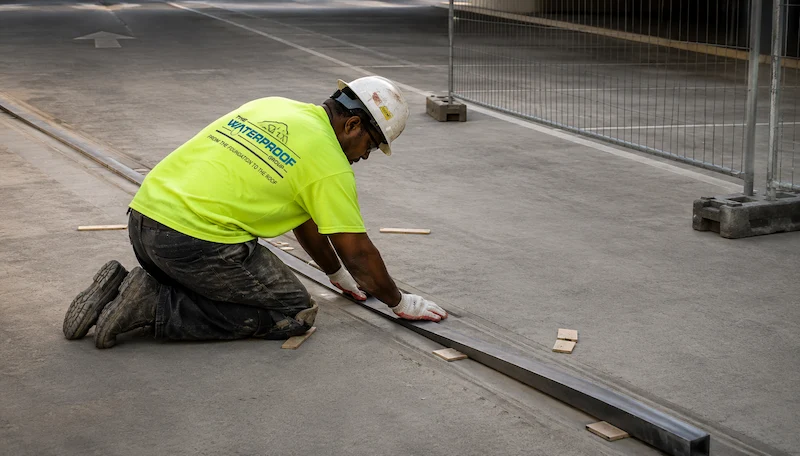
Expansion joints allow separate sections of a commercial structure to move without damaging the surrounding building materials. These joints are commonly found in parking garages, elevated decks, exterior walls, walkways and transitions between adjoining structures.
Because expansion joints must remain watertight while continuing to move, they are especially vulnerable to deterioration. Joint materials can split, lose adhesion, become compressed or pull away from the surrounding concrete.
A leaking expansion joint may allow water to enter occupied areas, parking levels, mechanical spaces or the concrete structure itself. Continued water intrusion can also contribute to corrosion of embedded reinforcing steel and deterioration of the surrounding concrete.
The repair may involve localized sealant replacement, installation of a new engineered joint system or repairs to damaged concrete around the opening. The correct approach depends on the amount and direction of movement, traffic exposure and existing joint configuration.
Our commercial expansion-joint waterproofing and repair services address leaking joints in parking structures, elevated decks and commercial buildings throughout Metro Atlanta.
5. Plaza Decks, Balconies and Other Horizontal Surfaces
Horizontal surfaces over occupied or usable areas must perform much like a roof. Plaza decks, balconies, elevated courtyards, walkways and pedestal-paver systems depend on waterproofing membranes, drains and properly detailed transitions to prevent water from reaching the structure below.
Leaks may develop when a waterproofing membrane deteriorates, drains become blocked, penetrations are improperly detailed or movement damages transitions between horizontal and vertical surfaces.
The finished surface can make these leaks difficult to locate. Water may enter through one area, migrate beneath pavers or topping slabs and emerge somewhere else below. Repeatedly sealing the underside of the deck generally does not correct a failed membrane above it.
Professional horizontal waterproofing systems can protect plaza decks, balconies, elevated courtyards and other surfaces located over occupied spaces.
Parking decks and pedestrian surfaces may instead require properly selected vehicular or pedestrian traffic coatings capable of providing waterproof protection while resisting vehicle traffic, foot traffic, abrasion and environmental exposure.
6. Below-Grade Foundations and Underground Structures
Water intrusion below ground level is frequently caused by groundwater, hydrostatic pressure, failed foundation membranes, leaking concrete cracks or improperly protected construction joints.
Common problem areas include foundation walls, elevator pits, tunnels, underground parking areas, retaining walls and wall-to-floor joints. Leaks may become more noticeable after heavy rainfall or during periods when the surrounding soil remains saturated.
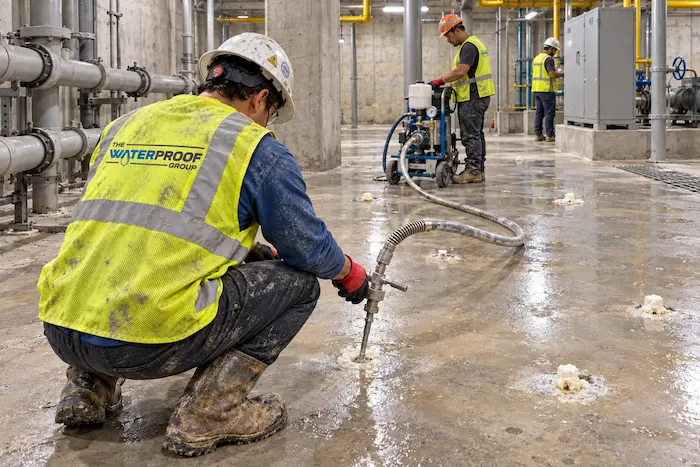
When the outside of the foundation is accessible, repairs may include excavation, positive-side waterproofing membranes and foundation drainage improvements. When excavation is impractical or cost-prohibitive, other approaches may include polyurethane injection, curtain-wall grouting or interior drainage systems.
Commercial below-grade water intrusion should be evaluated based on the building construction, water pressure, accessibility and exact leak location. There is no single waterproof coating that is appropriate for every underground leak.
Our commercial below-grade waterproofing services include waterproofing membranes, foundation drainage, concrete crack injection and curtain-wall grouting for commercial and underground structures.
7. Drainage Failures and Water Concentration
Some commercial building water leaks begin with the way water is being collected and discharged around the property.
Clogged roof drains, overflowing gutters, improperly directed downspouts, blocked scuppers and poorly sloped exterior surfaces can concentrate water at vulnerable areas of the building. On parking decks and plaza systems, blocked drains may leave waterproofing membranes submerged longer than intended.
At ground level, poor grading can direct runoff toward foundation walls rather than away from the structure. Even a properly installed waterproofing system can experience additional stress when large volumes of water are repeatedly concentrated against it.
Drainage should therefore be evaluated as part of the overall leak investigation. Repairing a membrane or joint without correcting the condition that continuously directs water toward it may result in another failure.
Warning Signs Property Managers Should Document
A good leak history can help narrow the investigation. Property managers, facility managers and maintenance personnel should record when the leak occurs, the weather conditions and exactly where the water becomes visible.
Important observations include:
- Whether the leak occurs during every rain or only during wind-driven storms
- Whether it begins immediately or several hours after rainfall
- Which direction the wind was blowing when the leak appeared
- Whether the water is near a window, wall, ceiling, floor or structural joint
- Photographs and videos taken while the leak is active
- Previous repairs performed in the same area
- Whether staining continues to grow during dry weather
Leaks that continue regardless of weather may indicate plumbing, HVAC, condensation or another internal source rather than exterior water intrusion.
How a Commercial Leak Investigation Works
An effective investigation begins by reviewing the leak history and examining both the interior damage and the exterior construction. The goal is to understand how the building is assembled and identify a realistic path from the suspected entry point to the visible damage.
Depending on the building and leak conditions, the process may include visual inspection, moisture testing, infrared imaging and controlled water testing. Testing should isolate individual areas whenever possible rather than soaking an entire wall and creating an unclear result.
Once the source has been identified, the repair should address the failed component—not simply cover the interior symptom. That may mean repairing a roof detail, replacing sealant, restoring an expansion joint, installing a waterproofing membrane or correcting drainage.
Our commercial leak investigation process is designed to identify the source before recommending a waterproofing repair.
Avoid the Cycle of Repeated Patch Repairs
Repeated patching is one of the most common and expensive mistakes made with commercial water intrusion. Applying roof cement, coating an interior wall or adding caulk without determining how water is moving through the assembly may temporarily change where the leak appears without stopping it.
A successful repair begins with the correct diagnosis. The repair material must also be compatible with the existing substrate, designed for the amount of movement and exposure present, and properly connected to adjoining waterproofing systems.
This system-based approach is especially important on large commercial properties where several components may meet within a relatively small area.
Frequently Asked Questions About Commercial Building Water Leaks
Does an interior ceiling stain always mean the commercial roof is leaking?
No. Roof failures are common, but water can also enter through parapet walls, exterior joints, windows, penetrations or wall systems and travel above the ceiling. The surrounding building envelope should be evaluated before assuming the roof is responsible.
Can commercial leaks be investigated when it is not raining?
Yes. Visible conditions, moisture readings, previous repair areas and construction details can be evaluated during dry weather. Controlled water testing may also be used to reproduce certain leaks systematically.
Why does a commercial leak return after being repaired?
The original repair may have addressed the visible symptom rather than the actual entry point. The repair material may also have been incompatible, improperly installed or unable to accommodate building movement.
Can below-grade commercial leaks be repaired without excavation?
Sometimes. Depending on the construction and source of water intrusion, curtain-wall grouting, polyurethane injection, interior drainage or other specialized methods may be possible when exterior excavation is not practical.
Who should investigate a commercial building leak?
That depends on the suspected source. Plumbing and mechanical leaks require the appropriate plumbing or HVAC contractor. Water intrusion through roofs, walls, joints, decks and foundations should be evaluated by a contractor experienced in commercial waterproofing and building-envelope systems.
Schedule a Commercial Leak Investigation in Metro Atlanta
Commercial water intrusion rarely improves on its own. Delayed repairs can damage interior finishes, insulation, stored materials, structural components and tenant spaces while increasing the cost and disruption of the eventual repair.
The Waterproof Group provides commercial leak investigation and waterproofing repairs for property owners, facility managers, general contractors and property-management companies throughout Metro Atlanta.
Call 678-223-4948 or visit TheWaterproofGroup.com to schedule a commercial waterproofing evaluation.